Goby Fish Trap Used by the Co-tu People
Thứ Hai, 02/06/2025
The Co-tu people have long resided in the northern area of the Truong Son mountain range, a region rich in rivers and streams. As a result, they frequently exploit aquatic resources to improve daily meals and to serve community rituals. Two main fishing methods are practiced: collective fishing and individual fishing. Typical collective fishing methods include the use of mildly toxic plant leaves (chong chưl), building temporary dams to block streams (chơ p'rôh), and using traps, scoop nets, or small fishing nets (t'riêl/p'riêu). Individual fishing tools used by the Co-tu are diverse, ranging from fish spears (dụ) and fish slingshots (pa'nanh) to scoop nets and fish traps.
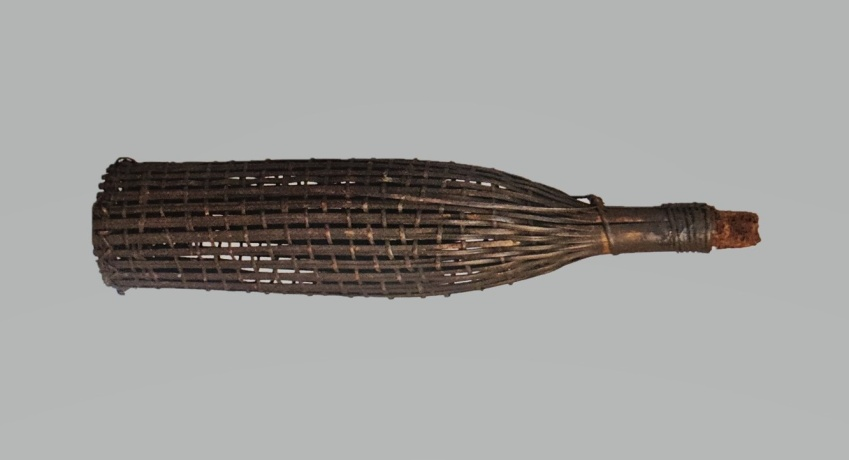
The goby fish trap (grăm) of the Co-tu people is a cylindrical tool made from bamboo and rattan. A bamboo tube about 1.4–1.5 meters long is used, with one node section (approximately 25–30 cm) kept intact to form the tail of the trap. Rattan is wrapped around it four to five times to prevent splitting. The remaining bamboo section is split into vertical strips and woven horizontally in a lattice pattern to create the trap body with a circumference of about 50 cm. The inner funnel is woven separately and placed inside the trap opening.
This type of trap is mainly used to catch gobies in streams and is typically used by men. Bait, usually worms, is placed inside the trap before it is submerged in stream sections where gobies are abundant. The trap opening is positioned against the water flow and secured with branches and small stones to prevent drifting. When fish enter the trap to eat the bait, the funnel prevents them from swimming back out. When not in use, the trap is hung above the kitchen hearth, where smoke and soot coat the surface, making it more durable. Today, the Co-tu people still use this trap due to its convenience, allowing this indigenous knowledge to continue being maintained in community life.
This trap was woven by a man from Aduong 1 village, Prao town, Hien district, Quang Nam province for household use. In 1996, he sold the trap to the Vietnam Museum of Ethnology. The artifact is currently preserved in the museum’s storage collection.
Author, Photo: Vu Phuong Nga