Seed Rice Storage Basket of the Bru–Van Kieu People
Thứ Ba, 05/11/2024
The Bru–Van Kieu people are one of the ethnic groups who have long resided in the Truong Son mountain range, mainly in Quang Tri, Quang Binh, and Thua Thien–Hue provinces. Their livelihood traditionally depends on swidden cultivation, with rice as the primary crop. Their farming method follows the process of “clearing, burning, digging, and sowing” (clearing forests, burning dried vegetation, making holes in the soil, and sowing seeds), using simple tools such as axes, machetes, digging sticks, and seed rice baskets.
|
|
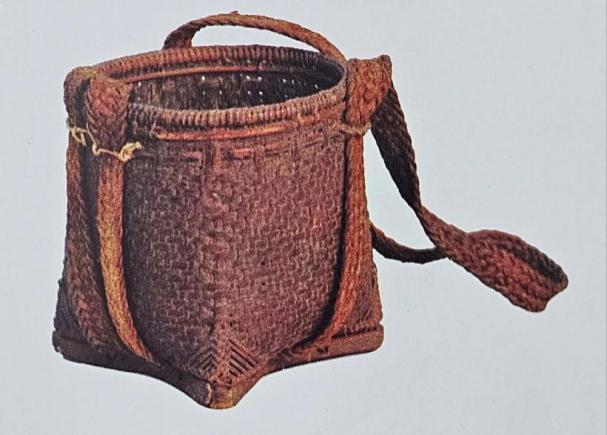
Seed Rice Basket of the Bru–Van Kieu People
Collected in 1996 at Ta Rung village, Huc commune, Huong Hoa district, Quang Tri province
Height: 18 cm, Diameter: 18.5 cm
Code: 1996.34.70
|
The seed rice basket (saro) is a small cylindrical basket, approximately 18 cm high, woven from split bamboo strips of the ralung plant using a lattice weaving technique. The round rim is carefully bound and braided with rattan. The base is low and square-shaped, with the edges formed from thick rattan bent inward. Rattan bindings are arranged into isosceles triangular patterns at the four corners, both securing the base to the body and creating decorative motifs. The single shoulder strap is braided from rattan and fixed through the gap between the base and the bottom of the basket.
The seed rice basket is one of the woven products traditionally made by Bru–Van Kieu men. Sometimes it is also used to hold medicine or betel when receiving guests, but it is mainly used by women to carry rice seeds during sowing. The strap is worn across the shoulder so that the basket rests at hip level, allowing easy access to the seeds when placing them into holes made in the soil.
This basket was woven in 1992 by Mr. Ho Van Di, a Van Kieu man from Ta Rung village, Huc commune, Huong Hoa district, Quang Tri province, and later sold to the family of Mrs. Ho Thi Mun. She used it until July 31, 1996, when it was sold to the Vietnam Museum of Ethnology. The basket is currently preserved in the museum’s storage collection.
Author: Vu Phuong Nga
Photo: BTDTHVN