Traditional Pillow of the Co-tu People
Chủ Nhật, 02/03/2025
The Co-tu people are one of the ethnic minority groups who have long resided in the northern area of the Truong Son mountain range. They are mainly concentrated in Tay Giang, Dong Giang, and Nam Giang districts of Quang Nam province, with smaller communities living in Thua Thien–Hue province. Their primary livelihood is swidden cultivation. In addition, gathering forest products helps supplement household food supplies and provides materials for making everyday household items.
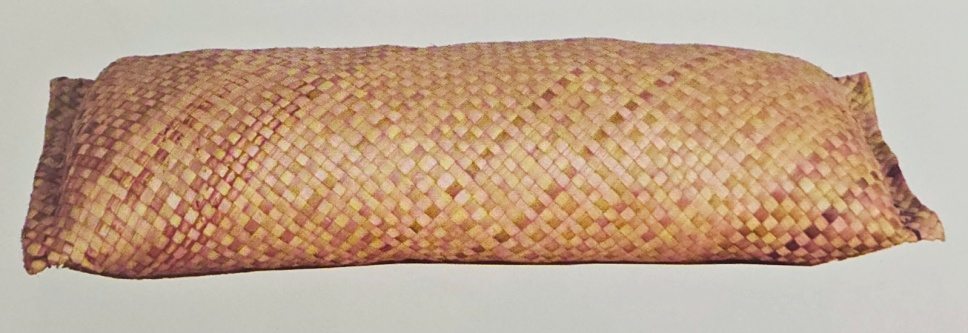
Pillow of the Co-tu People
Collected in 1996 at Arung hamlet, Ba Le commune, Tay Giang district, Quang Nam province
Code: 1996.12.195-1
Chơ-ơih — a type of pillow used for resting the head — is one of the household items used in the daily life of the Co-tu people. The pillow is long, narrow, and soft, made from forest leaves. The filling consists of dried banana leaves, while the outer cover is made from the leaves of a wild pineapple plant (alớh). The leaf edges with thorns are removed, split into strips, dried for several days, and then woven using a lattice technique to form the pillow cover. To dye the strips, the bark of a forest tree (a păng) is boiled in water to produce a reddish-brown color, after which the pineapple strips are boiled for about half an hour or soaked overnight. For decoration, dyed and undyed strips are woven alternately to create a visually balanced pattern.
This pillow was made in 1990 by the wife of Mr. Bling Bien from Arung hamlet, Ba Le commune, Tay Giang district, Quang Nam province, and was used as a sleeping pillow. This type of leaf pillow is also common among the Ta Oi people, where it is known as xơ-col. Among both ethnic groups, pillows are made by women, and there are also paired pillows for young married couples. Today, this type of leaf pillow is still used by local communities. The artifact is currently preserved in the museum’s storage collection.
Author: Vu Phuong Nga
Photo: Vietnam Museum of Ethnology