Traditional Doi Calendar of the Muong People
Thứ Hai, 09/12/2024
The Muong people have long resided in Vietnam and possess a rich cultural heritage with distinctive ethnic characteristics. They mainly live in Hoa Binh province and mountainous areas of Phu Tho, Thanh Hoa, and neighboring provinces. In the past, their primary economic activities included wet-rice cultivation combined with swidden farming, animal husbandry, hunting, gathering, and handicraft production. Therefore, the use of a calendar to plan agricultural activities and daily life played an important role in Muong society.
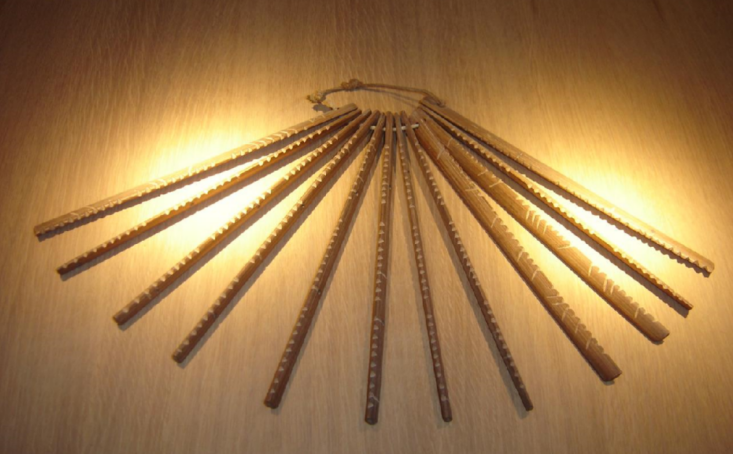
Traditionally, the Muong people used their own calendar based on the movement of the Tua Rua constellation (known as the Doi/Roi star) and the lunar cycle. The calendar was carved onto twelve bamboo slips corresponding to the twelve months of the year, and was therefore also known as the bamboo calendar (or Doi/Roi calendar). Each bamboo slip bears symbols indicating the month at its top, while days and natural phenomena such as rain, wind, fish, and animals are marked along the sides. Each month is divided into three periods: the first ten days (kâl), the middle ten days (lôồng), and the last ten days (cối). The Muong people used the bamboo calendar to determine auspicious and inauspicious days for production activities (cultivation, fishing, hunting), daily activities (buying buffaloes, building houses), life-cycle rituals (weddings, funerals), and community festivals.
Today, only a small number of Muong people still know how to use the bamboo calendar. In 2022, the folk knowledge associated with the bamboo calendar (Doi/Roi calendar) was recognized as a National Intangible Cultural Heritage.
This calendar set was made in 1976 by Mr. Bui Van Nghe from Khang hamlet, Van Son commune, Lac Son district, Hoa Binh province. It was collected by the Vietnam Museum of Ethnology in 1996 and is currently displayed in the exhibition area on ethnic groups belonging to the Viet–Muong language group on the first floor of the Dong Son Drum building.
Author: Vu Thi Thanh Tam
Photo: BTDTHVN