Traditional Arrow Quiver of the Co-tu People
Thứ Sáu, 28/02/2025
The Co-tu people mainly reside in the mountainous districts of Thua Thien–Hue and Quang Nam provinces, where their lives have long been closely connected to the forest. Hunting was therefore once an important means of livelihood. Bows and arrows were traditional hunting tools and weapons commonly used by Co-tu men.
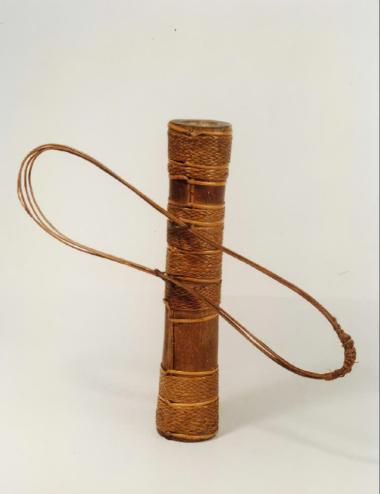
The arrow quiver used during hunting (chi-ó) is typically made from mature bamboo. A straight, cylindrical section with closed nodes at both ends is selected and cut into two parts: the longer section serves as the quiver body, while the shorter section becomes the lid. Both parts are shaved down so that when fitted together, the quiver becomes slender in the middle and slightly flared at both ends. To prevent cracking and for decoration, thin rattan strips are split and woven in a crossed double pattern, forming wide bands around both ends of the quiver. Adjacent bands are separated by a thicker rattan ring. The strap consists of four sharpened bamboo loops joined together.
The quiver contains different types of arrows depending on the hunted animal. Some hunters also place sacred leaves or talismanic objects inside the quiver, believing they bring luck during hunting. When going into the forest, hunters carry the quiver over their shoulder. Today, bows, arrows, and arrow quivers are no longer as commonly used as in the past.
This quiver was crafted and used by Mr. Alang Thanh from Zơra village, Ta Bhing commune, Giang Nam district, Quang Nam province, and was later sold to the Vietnam Museum of Ethnology in 1994. The artifact is currently displayed in the exhibition area on ethnic groups belonging to the Mon–Khmer language family on the second floor of the Dong Son Drum building.
Author: Nguyen Thi Thuy Duong
Photo: Vietnam Museum of Ethnology